
Best GPU in PC Store Together: Tier by Tier
The Halven GPU line in PC Store Together explained: VTX 8090 Ultra, 5070, 4060, 3040, 2060 and Legacy AG, with build pairing and pricing advice.
Quick answer: The Halven NoVex VTX 8090 Ultra is the best graphics card in PC Store Together. The VTX 5070 is the best value for high-end customer builds, the VTX 4060 is the safe mid-range pick, and the Legacy AG cards are budget parts, not premium ones.
Official source: PC Store Together on Steam ↗
Graphics cards are the most visible part of a build and the easiest way to ruin its margin. The card decides the benchmark score, the power draw, the case clearance and the price the customer will accept. This page ranks the Halven line by build role and explains what each card forces you to upgrade. For the rest of the parts, use the tier list→.
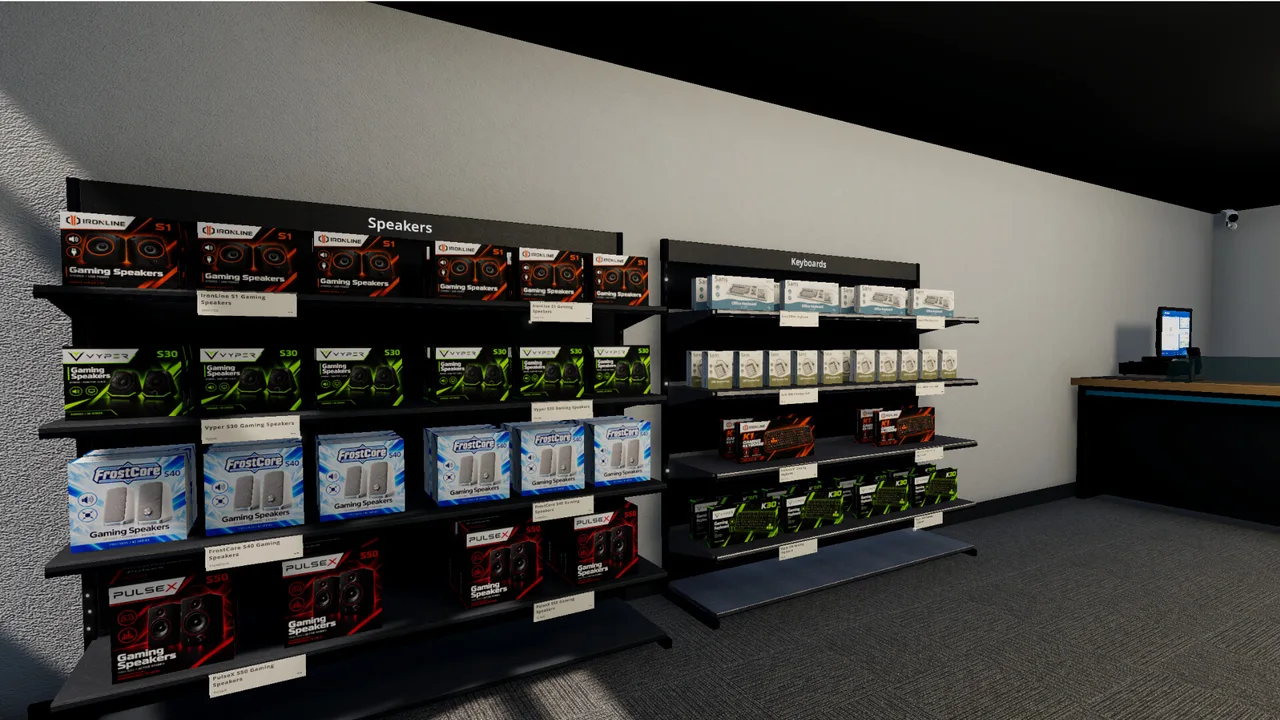
The Halven line at a glance
| Card | Line | Role | What it forces |
|---|---|---|---|
| NoVex VTX 8090 Ultra | Enthusiast | Showcase and high-budget builds | Large case, high-wattage PSU, strong cooling |
| NoVex VTX 5070 | High-end | Premium customer builds | Quality PSU with headroom |
| NoVex VTX 4060 | Mid-range | The default custom build | A normal ATX case and a 550–650 W class PSU |
| NoVex VTX 3040 | Entry | Budget builds and light gaming | Nothing unusual, but caps the score |
| NoVex VTX 2060 | Entry | Repairs and office machines | A display output, not a benchmark hero |
| Legacy AG 300 Duo | Legacy | Cheap builds | Accepts a low price, not a high one |
| Legacy AG 100 | Legacy | Display-only machines | The lowest acceptable card |
The exact catalogue rotates with reputation, so treat the model names as a hierarchy rather than a fixed shop list. If a card is not on the shelf, the tier below it is the substitute, not a random card from another brand.
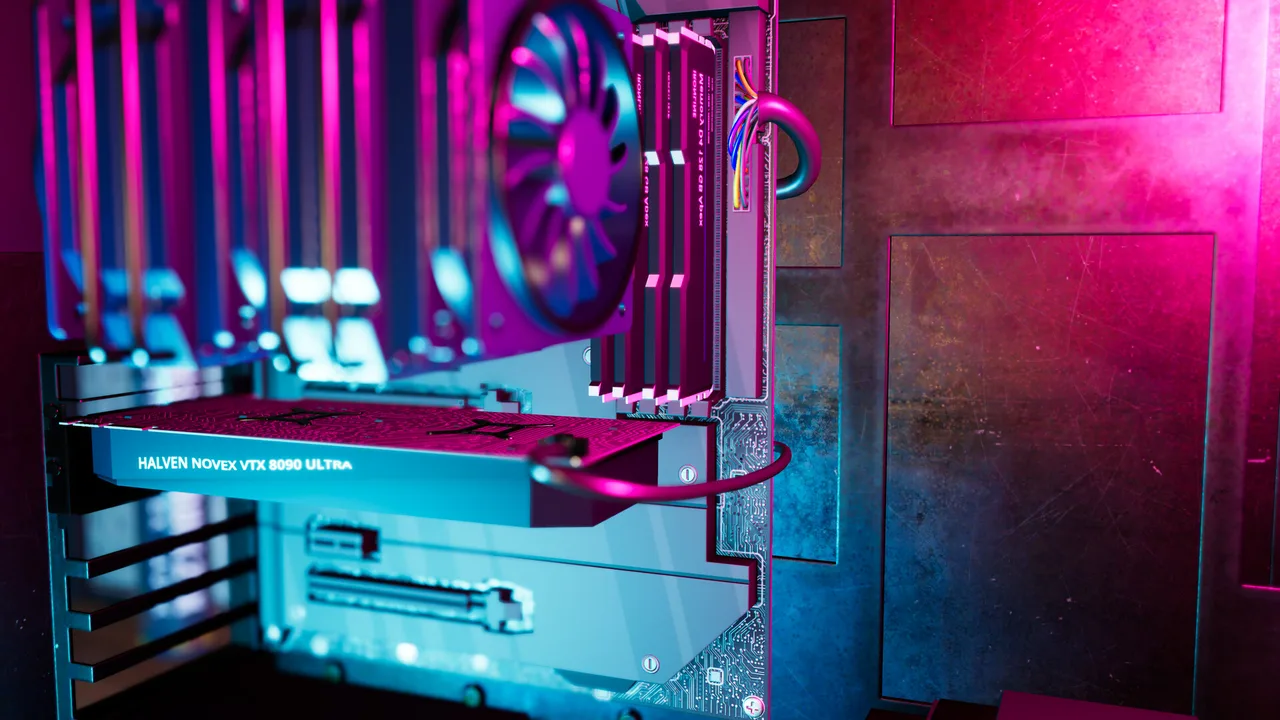
Why the 8090 Ultra is the top card
It is the card used in the game's own showcase build, mounted in a large white case with a 1200 W power supply label visible. That is the intended pairing: a card this size needs case length, airflow and a PSU that can feed it without shutting down under load.
Use it when:
- The customer's budget clearly supports a premium build.
- The case has room for a long card and the cooler still fits.
- The PSU is rated above the build's peak draw, not exactly at it.
- You want a display PC that justifies a high price tag.
Do not use it when the customer's budget only covers the card. A premium GPU with a weak CPU, small case or tight PSU produces a machine that passes idle and fails the load test.
The value picks: VTX 5070 and 4060
The 5070 is the sweet spot for a customer who wants a serious machine but flinches at the flagship price. The 4060 is the default for a normal custom build: strong enough to justify a premium over a repair, cheap enough to leave margin.
Both cards pair with a mid-tower case and a quality PSU. Neither should force a cooler upgrade on its own. If the build sheet shows a wattage problem with a 4060, the PSU is undersized for the whole machine, not just the card.
A GPU's resale value in the inventory is not the price a customer pays for a finished PC. Price the whole machine against parts cost and bench time.
The budget cards: VTX 3040, 2060 and Legacy AG
These cards exist to make a low-budget build possible. They are not bad parts; they are bad premium parts.
- VTX 3040: the best of the budget tier. Use it when the customer needs a working gaming PC and the budget will not stretch to a 4060.
- VTX 2060: a repair-grade card. It gives a display output and handles light use, but it will not carry a high price.
- Legacy AG 300 Duo: a cheap card for cheap builds. Pair it with a basic CPU and a small PSU.
- Legacy AG 100: the floor. Use it only when the job is "make this machine display something", not "build a gaming PC".
The inventory screen shows resale values around $12 for the AG 100, $41 for the AG 300 Duo and $37 for the VTX 2060. Those numbers are what the shop pays to take the part back, not what you charge. Marking up a $37 resale card as if it were a $370 card is the fastest way to lose a customer.
Matching the card to the rest of the build
Work in this order:
- Budget. What can the customer actually pay?
- Card tier. Pick the highest card the budget supports after the other parts.
- PSU. Add up peak draw and leave headroom. The PSU guide→ has the rule.
- Case. Check card length and cooler height before installing.
- Cooling. A hotter card needs more intake and exhaust.
- Benchmark. Run the load test and read peak temperature, not idle.
A card that fits the board but not the case is still a failed build. The compatibility guide→ covers clearance and slot checks.
When a GPU is not the upgrade the customer needs
A customer complaining about a slow machine may need storage or memory, not a graphics card. A machine that shuts down under load is usually a PSU or thermal problem, not a weak GPU. A machine with no display can be a seating issue, a dead card or a monitor cable.
Diagnose before you sell. The diagnosis flowchart→ starts with the symptom, not the part. Replacing a working GPU with a more expensive one is a refund waiting to happen.
Display PCs and the premium card
The showcase build is where the 8090 Ultra earns its keep. A finished display PC with a premium card, clean cable work and a high price tag signals what the shop can do. The display price is set by you, and customers judge it against the build, not the card alone.
A display PC with a flagship card but a cramped case or a stock cooler reads as an expensive mistake. Spend the extra time on cable routing and airflow, then price it as a complete machine. The display PC guide→ covers the sales side.
Sources
- PC Store Together on Steam ↗ — official screenshots including the VTX 8090 Ultra showcase build.
- PC Store Together Steam news ↗ — patches affecting hardware and selling rules.
- PC Store Together on SteamDB ↗ — build history.
- Sykes Games ↗ — developer site.
FAQ
What is the best GPU in PC Store Together? The Halven NoVex VTX 8090 Ultra is the top-tier card, used in the game's 1200 W showcase build.
What is the best value GPU? The VTX 5070 for premium builds and the VTX 4060 for normal custom builds.
Can I sell a PC without a GPU? No. A patch requires a graphics card before a custom PC can be sold.
Are the inventory prices retail prices? No. They are resale values shown when you sell a part back, not the price a customer pays for a finished build.